
SPF, DKIM, and DMARC Explained for US Small Businesses
A plain-English guide for US small businesses setting up SPF, DKIM, and DMARC before sending sales, marketing, or customer email at scale.
This guide is written for US SMB owners, marketing teams, agencies, IT generalists, and founders using Google Workspace, Microsoft 365, and sending platforms. It is intentionally focused on the United States because US teams face a specific combination of CAN-SPAM obligations, Gmail and Yahoo sender requirements, Microsoft consumer-mail enforcement, Apple privacy effects on open tracking, and high expectations from B2B recipients who can report unwanted mail instantly.
The practical answer is simple: do not treat cold email, list building, verification, deliverability, and analytics as separate activities. A US B2B campaign is safest when the list, sender identity, message, unsubscribe path, and reporting loop are checked together before volume increases.
Why this matters for US buyers
US buyers searching for this topic are usually not browsing casually. They are trying to solve a real campaign problem: understand the rule, diagnose a delivery issue, compare a tool, clean a list, or decide whether it is safe to send. This guide keeps the answer practical so you can move from research to a better operating decision.
The best use of this page is to treat it as a decision checklist. If you are evaluating BuffSend, compare your current process with the controls a serious email operation needs: verified data, authenticated senders, clear messaging, suppression handling, and measurement that shows whether email is creating revenue safely.
Search intent summary
Small business operators want to understand what the DNS records do, whether they are required, and how to check them without becoming email administrators.
The target US query family for this page is:
- SPF DKIM DMARC explained
- email authentication small business
- DMARC policy p=none
- SPF DKIM DMARC Gmail requirements
Fact-check sources used
The factual claims in this article are anchored to primary or high-quality sources checked on June 5, 2026. The main source categories are mailbox-provider rules, US commercial email law, privacy behavior that affects measurement, and email benchmark research. Provider pages change over time, so the links should be rechecked whenever the article is materially updated.
- Google says all senders must use SPF or DKIM, and bulk senders must satisfy stricter authentication and alignment expectations; see Google email sender guidelines.
- Yahoo requires bulk senders to implement both SPF and DKIM and publish a valid DMARC policy with at least p=none; see Yahoo Sender Hub best practices.
- Microsoft high-volume sender guidance expects SPF and DKIM to pass, a DMARC record to exist, and DMARC validation to pass through aligned SPF or DKIM; see Microsoft Outlook high-volume sender requirements.
- Google states that bulk senders who do not meet sender requirements can see temporary and permanent rejection disruptions beginning with ramped enforcement; see Google sender guidelines FAQ.
The short answer for US teams
If you only remember one thing from this article, remember this: every email campaign is a chain of trust. The chain starts with the contact source, continues through verification and authentication, shows up in the message itself, and ends in the recipient's response. When one link is weak, the campaign becomes harder to deliver, harder to defend, and harder to measure.
That is why a focused workflow beats a pile of tips. A team that checks the sender, verifies the list, writes clear copy, includes opt-out handling where required, and monitors provider-specific signals can learn from every send. A team that simply adds more contacts or more mailboxes often scales the original problem.
US businesses also need to separate legality from deliverability. A message can satisfy a legal checklist and still land in spam if recipients do not want it, if the sender has weak reputation, or if the list is stale. The inverse is also true: a message can appear deliverable during a small test and still create compliance or trust risk if identity, subject lines, opt-out handling, or suppression logic are sloppy.
Operational workflow
Start with the visible From domain
The domain recipients see in the From address is the domain that must earn trust. Do not only configure a vendor subdomain and ignore the brand domain if the campaign appears to come from the brand domain.
Publish one correct SPF record
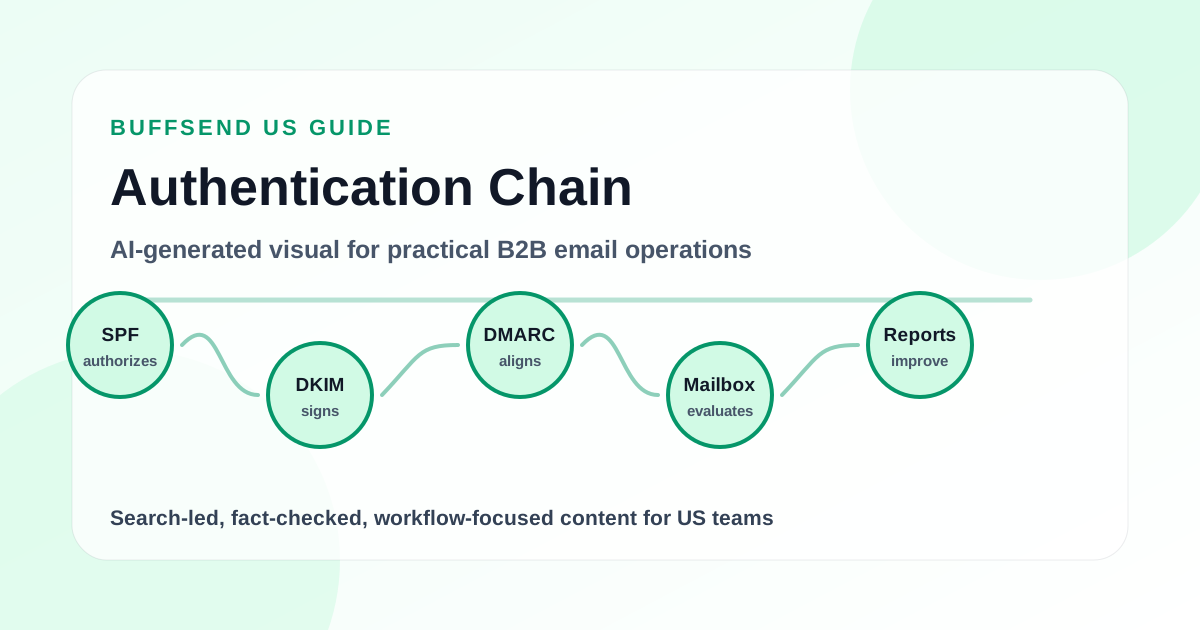
SPF lists the services allowed to send for a domain. Multiple SPF TXT records can break evaluation. Keep one record, include only active senders, and remove old vendors when they are no longer used.
Enable DKIM signing for every sender
DKIM adds a cryptographic signature. In practical terms, the email platform gives you a selector and DNS record. Publish the selector, wait for DNS propagation, then confirm that live messages are actually signed.
Add DMARC monitoring
DMARC connects SPF and DKIM results to the visible From domain. Start with p=none if you need visibility, route aggregate reports to a monitored address or parser, and move toward stricter policy when legitimate senders are aligned.
Check live messages, not only DNS
DNS can look correct while the actual campaign fails alignment. Send a test to Gmail and Outlook, inspect headers, and confirm SPF, DKIM, and DMARC results from the receiving side.
How to make the article actionable inside the team
Assign one owner for the pre-send checklist. In a small team, that might be the founder or sales lead. In a larger team, it might be RevOps, marketing operations, or sales operations. The owner does not need to write every email, but they should control the launch gate. No campaign should go live until sender setup, list state, compliance basics, and measurement tags are confirmed.
Create a campaign brief for each send. The brief should include the business goal, audience segment, source list, verification date, sender domain, message version, unsubscribe path, expected volume, and stop conditions. This keeps a growing outbound program from turning into guesswork.
Use provider-specific learning. Gmail, Microsoft, Yahoo, and corporate gateways can behave differently. A campaign average can hide the fact that one provider is rejecting mail, one segment is bouncing, or one list source is generating complaints. Segment-level reporting is more useful than a single blended open rate.
How BuffSend helps buyers act on this
BuffSend is built for teams that want this guidance to become a working process, not another checklist that gets forgotten. The platform helps you check the sender, verify the list, segment risk, write a clearer message, launch carefully, and monitor outcomes from the same campaign workflow.
For a production workflow, add this checklist to the campaign launch process. First, verify contact records and remove invalid or suppressed addresses. Second, confirm SPF, DKIM, and DMARC for the sending domain. Third, review copy for clarity, truthfulness, and risky content. Fourth, send a smaller pilot segment before scaling. Fifth, monitor bounces, unsubscribes, negative replies, and provider-specific performance instead of looking only at opens.
Buyer questions to ask before you scale
Before you choose a tool or approve a larger send, ask three buyer-facing questions. First, will this workflow reduce the amount of bad data your team handles, or will it only make sending faster? Faster sending without cleaner data usually increases bounce, complaint, and compliance risk. Second, can the workflow show where performance changes by list source, mailbox, buyer persona, and recipient domain? A useful platform should help you see whether the problem is the audience, the sender, the message, or the provider environment.
Third, does the process make it easy to pause? A buyer-friendly outbound system should not trap you into continuing a campaign when bounces, negative replies, or unsubscribes rise. The practical standard is simple: you should be able to verify the list, review the sender, adjust the message, suppress risky contacts, and restart with a smaller segment before you spend more budget or expose the domain to more risk.
Mistakes to avoid
- Publishing two SPF records instead of merging mechanisms into one record.
- Turning on DKIM in DNS but forgetting to enable signing in the sending platform.
- Adding DMARC with p=reject before identifying all legitimate senders.
- Assuming a vendor-managed return-path automatically aligns with the visible From domain.
- Leaving old sending services in SPF forever, which broadens who can send for the domain.
Pre-launch checklist
- Confirm the buyer problem and campaign goal before adding contacts.
- Recheck compliance and provider requirements before changing launch rules.
- Keep the article tied to one BuffSend workflow and one primary CTA.
- Verify sender authentication and list quality before recommending scale.
- Measure replies, bounces, complaints, unsubscribes, and revenue outcomes after launch.
Measurement after launch
After a campaign launches, the first report should not be a celebration of send volume. The first report should answer whether the campaign behaved safely. Look at delivered messages, hard bounces, soft bounces, unsubscribes, spam complaints where available, negative replies, positive replies, meetings, conversions, and provider-specific performance. Then compare those outcomes to the source list and message version.
Do not make major decisions from one metric. Opens can be useful directionally, but privacy protections and security scanners can change what an open means. Replies can be stronger, but replies need quality labels. Clicks can indicate interest, but bots and link scanners can distort them. Revenue and qualified pipeline matter most, but they may arrive later. The best dashboard shows early risk signals and downstream business outcomes together.
When the numbers look bad, pause before scaling. A deliverability problem usually gets more expensive as volume increases. The team should inspect list source, verification status, authentication, content, sender volume, recipient provider, and suppression behavior before adding more contacts or mailboxes.
US buyer operating model
Keep this workflow tied to US market behavior. A US prospecting campaign often reaches a mix of personal Gmail addresses, company Google Workspace inboxes, Microsoft 365 business inboxes, Outlook.com or Hotmail addresses, Yahoo-managed addresses, and corporate security gateways. Those environments do not evaluate mail in exactly the same way. That is why the campaign owner should review performance by recipient domain family, contact source, persona, sender mailbox, and message version rather than relying on one blended campaign average.
Use a simple review cadence. Before launch, confirm the legal and deliverability checklist. During the first send window, watch bounces, provider-specific failures, negative replies, unsubscribes, and any signs of rate limiting. After the first meaningful sample, decide whether to scale, hold, rewrite, re-segment, or suppress. After the campaign closes, write down what changed: which source list performed best, which persona responded, which sender had trouble, which domain family created friction, and which call to action created qualified pipeline.
Once this workflow is in place, review performance by buyer segment rather than by campaign average. A founder, agency owner, sales leader, recruiter, and RevOps operator may all respond differently to the same message. Segment-level learning tells you which buyers are worth more investment and which segments should be paused or rewritten.
Update the workflow when mailbox-provider requirements change, when your sending volume changes materially, when your buyer segment shifts, or when support and sales teams hear the same objection repeatedly. The goal is to keep the buyer journey accurate, compliant, and useful before more volume goes out.
FAQ
What is SPF in simple terms?
SPF is a DNS record that says which mail servers or services are allowed to send mail for a domain. Receivers check it against the envelope sender, not just the visible From address.
What is DKIM in simple terms?
DKIM signs the message with a domain key. The receiving server checks the signature against a public DNS record to confirm the message was authorized and not modified in transit.
What is DMARC in simple terms?
DMARC tells receivers how to evaluate messages that claim to be from your domain. It uses aligned SPF or DKIM results and can provide aggregate reports so you can see who sends using your domain.
Should a small business use p=none, quarantine, or reject?
Many small businesses start with p=none to monitor. Move to quarantine or reject only after you confirm legitimate senders pass alignment and your reports do not show important broken mail streams.
Final recommendation
Use BuffSend SPF, DKIM, and DMARC tools as a preflight before sending any new campaign from a custom domain.

A focused US email program should be boring in the right places: accurate identity, clean data, verified addresses, authenticated domains, clear copy, compliant unsubscribe handling, cautious volume, and honest measurement. The creative work belongs in relevance and positioning. The operational work belongs in making sure the sender earns trust before asking for attention.